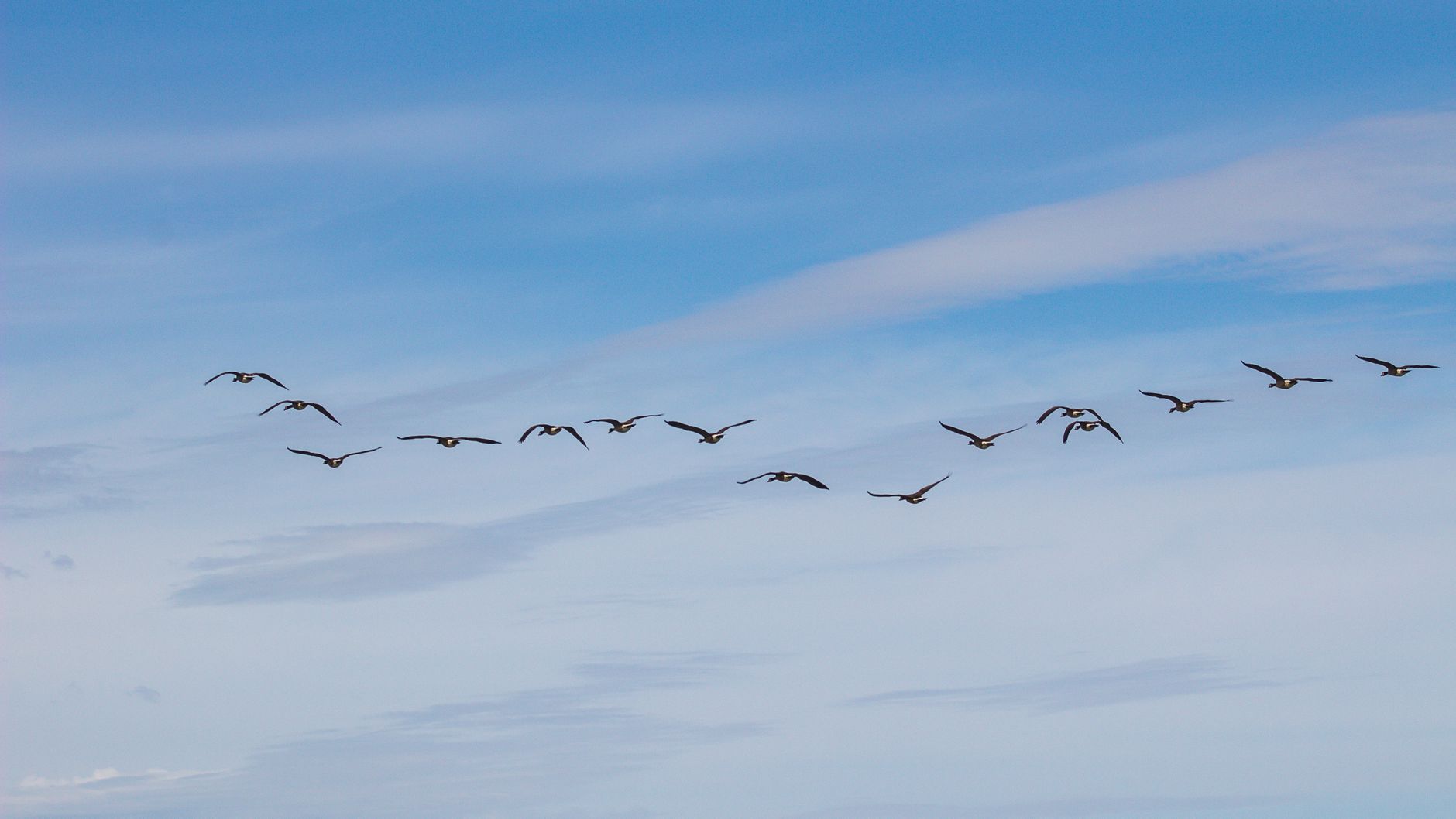
The sight of geese forming a V-shape or swallows lined up on power lines indicates a transition into a new season. However, there may be no apparent reason why numerous bird species perform these migrations. Most of these migrations occur based on the availability of food and suitable breeding ground. In order to survive, Birds must travel to warmer climates to avoid the harsh conditions of winter. Winter in the northern part of their range causes the demise of insects, the depleting of fruit bearing trees, and the freezing of bodies of water resulting in the reduction of aquatic life. If a warbler or an osprey remained at home during the winter months, they would face starvation.
Food availability
It goes without saying that the main driver of southern migration of Birds is food. When winter sets in on northern latitudes, insects perish or enter dormancy, the trees that produce fruit are stripped of their leaves and branches, and the bodies of water are frozen over, thus eliminating the option for aquatic Birds to feed. For example, a warbler that eats insects or an osprey that feeds on fish would face certain death if they were to stay in their northern breeding locations because there would be little to no food available.
Additionally, while some Birds are adapted to withstand extremely low temperatures (for example chickadees), many Birds are not. Prolonged exposure to severe cold can result in increased energy demands at a time when food is scarce. Although feather insulation is beneficial, Birds exposed to extreme cold for lengthy periods may encounter difficulty foraging and are susceptible to frostbite and hypothermia. Therefore, southern destinations provide Birds with protection from severe cold and allow them to obtain food more readily than in colder climates.
Successful reproduction and predator avoidance
In addition to obtaining sufficient food and avoiding cold temperatures, the long-term viability of a species depends on reproductive success. Northern latitudes provide ideal conditions for reproduction. During the short-lived but highly productive summer months, the long days allow both males and females ample opportunities to forage. The resultant abundance of plant and animal biomass provides optimal nutrition for both adult Birds and their offspring. Additionally, many northern breeding locations lack predators that threaten the eggs and chicks of Birds.
When the breeding season ends and the chicks leave their nests, the decline in food availability and onset of cold temperatures make northern breeding locations undesirable, thus encouraging Birds to begin their southerly migration.
Energy costs of migration
The energy requirements of migration are substantial. Prior to migrating, Birds experience significant physiological changes, including the accumulation of fat stores that serve as an energy rich resource. Fat stores can comprise up to 50% of a bird’s body weight prior to long distance migration. This accumulated fat serves as a slow-burning fuel during the bird’s long distance migration.
Ruby throated hummingbirds exemplify One extreme form of long distance migration. These Birds migrate non-stop across the Gulf of Mexico, approximately 500-600 miles (800-1,000 km), which takes about 18-22 hours. Their energy stores consist almost exclusively of fat reserves. Thus, the tremendous energy expenditure required to complete these extraordinary feats of endurance must represent an evolutionary advantage in terms of acquiring abundant food sources and safely reproducing in warmer climates.
Navigation: how do Birds find their way?
Perhaps One of the most fascinating aspects of avian migration is the impressive ability of Birds to navigate accurately over vast distances. In fact, many Birds return to specific breeding and wintering grounds each year. Researchers have identified several ways that Birds employ navigation strategies:
- Earth’s magnetic field: avian magnetoreception allows Birds to detect the Earth’s magnetic field lines. Research has demonstrated that avian photoreceptors in their eyes are sensitive to magnetic fields, allowing Birds to visually perceive magnetic field lines.
- Sun compass: similar to how sailors used the sun as a directional reference point, many Birds employ the position of the sun as a guide. Some studies suggest that Birds can adjust their course daily to account for solar declination.
- Star compass: many nocturnally migrating Birds rely upon constellation patterns and/or polar starlight to navigate. Studies conducted within simulated environments (i.e., a planetarium) have provided evidence suggesting that some migratory species can realign themselves when presented with altered star configurations.
- Olfactory Cues: while still speculative, some researchers propose that olfactory Cues enable Birds to identify unique odors associated with their breeding/wintering grounds over relatively short ranges.
- Landmarks: Birds probably utilize recognizable topographic features (e.g., mountain ranges, coastlines, etc.) to help determine their geographical location over shorter ranges.
Young Birds usually acquire knowledge regarding migratory route through accompanying their parents or older/more-experienced conspecifics during their initial migration.
The evolutionary history of migrations: an energy-efficiency paradigm
Avian migrations did not evolve as a fixed trait but rather as a flexible adaptive response. Over thousands of generations, these behaviors have been influenced by climatic fluctuations (e.g., glacial/interglacial cycles). Initially, ancestral Birds presumably migrated only over short distances. Subsequently, as climate variability caused periodic surges in food availability at higher latitudes during favorable periods (e.g., warm summers), selective pressures favored the emergence of longer-range migrations among species capable of taking advantage of improved resources.
For migratory species, there exists an inherent trade-off between staying in a location versus undergoing migration. Remaining stationary implies a risk of starvation or mortality due to cold temperatures. Conversely, migrating poses risks of energy depletion, predator capture, or becoming disoriented. Nevertheless, for hundreds of species, the advantages offered by migration (access to abundant food supplies, safer breeding Habitat, and milder climates) have outweighed these considerable disadvantages, ultimately yielding the wide variety of migratory behaviors observed today.
Why do all Birds not migrate?
Not every type of bird migrates. There exist examples (e.g., cardinal or woodpecker/jay families) of resident Birds. Resident Birds have adapted mechanisms for surviving in their northern habitats during winter. They alter their diets (from insects to seeds/nuts), develop thicker insulating layers (thus remaining warmer) or seek shelter/safe havens with reliable food sources accessible year round.
Do Birds migrate alone or in flocks?
Some individual species (smaller ones like warblers/thrushes) tend to migrate either individually or in scattered groups. Other larger species (waterfowl like geese/cranes) tend to migrate in large cohesive groups/flocks. Birds migrating in groups (especially in V-formations) save energy compared to individual migration by decreasing air resistance experienced by trailing Birds.
What impacts does climate change/human activity exert on avian migrations?
Climate change affects avian migrations profoundly. Rising global temperatures can disrupt well-established migration Cues causing some migratory species to delay their departure times or fail to reach traditional southern locations thereby possibly missing optimal food resources. Human activities (Habitat destruction/fragmentation) also damage critical stop-over habitats/wintering habitats limiting already hazardous migrations further. Artificial light pollution also disrupts nocturnally migrating Birds.
Stop-over sites
Stop-over sites are vital areas where Birds can pause during their extensive migrations. At stop-over sites (which can be wetlands, forest edges/coastal areas) Birds need only rest/replenish their energy stores prior to continuing their migration. Stop-over sites play a vital role in ensuring that many Birds will survive their migrations.
Migration is an adaptation utilized by Birds for millions of years. Migration represents an intricate interplay between finding food for survival, avoiding harsh climate conditions and successfully producing young. All three components are connected via various remarkable forms of navigation and physiologic adaptations that allow these incredible journeys to continue to thrive today.
Sources
- The Basics: How Birds Navigate — Cornell Lab of Ornithology
- Why do birds migrate? — U.S. Geological Survey
- Why Do Birds Migrate South for Winter? — National Audubon Society
- How Do Birds Navigate So Well? — Scientific American
- Arctic Tern — National Geographic